
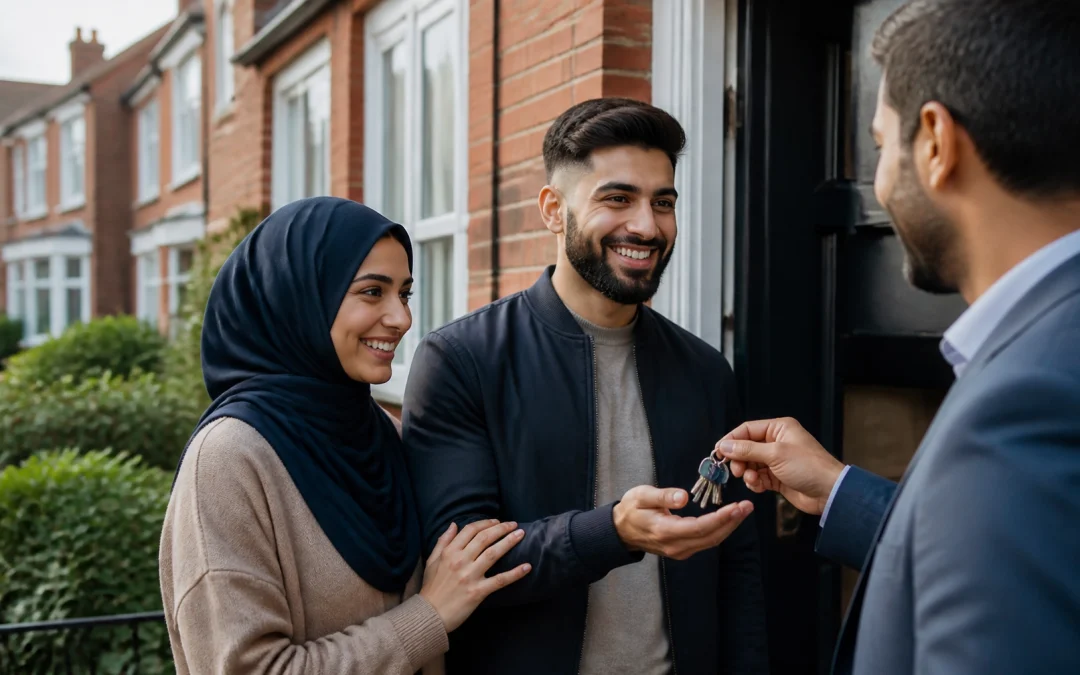
Facebook summary: Buying your first home while staying true to your faith is becoming more accessible in the UK. Discover how halal mortgages and Sharia-compliant Home Purchase Plans work in 2026, how they compare with conventional mortgages, and how Hunter Capital can help you find the right option.
For many Muslim first-time buyers, owning a home is an important goal : but a conventional mortgage may not be suitable because it involves paying interest, known as riba.
The good news is that the UK now has a growing range of Islamic mortgage options, often called halal mortgages or Sharia-compliant Home Purchase Plans. These products are structured around buying, leasing or co-owning an asset rather than lending money with interest.
In this guide, we explain how halal finance works for first-time buyers in 2026, the main types of Islamic mortgage available, and what to consider before applying.
What is a halal mortgage?
A halal mortgage is a way of buying property without an interest-bearing loan.
Under Islamic finance principles:
- Interest, or riba, is not charged.
- Finance is linked to a real asset, such as a house.
- The arrangement is based on trade, rent, partnership or shared ownership.
- The costs and responsibilities should be explained clearly.
- Investments must avoid prohibited activities and excessive uncertainty.
In the UK, an Islamic mortgage is usually legally structured as a Home Purchase Plan (HPP). Although people commonly use the term “Islamic mortgage”, an HPP is different from a conventional mortgage because the provider does not simply lend you money and charge interest.
Instead, the provider may:
- Buy the property and sell it to you at an agreed profit.
- Buy the property and lease it to you.
- Buy the property jointly with you and gradually sell you its share.
You still make regular monthly payments and eventually aim to own the property outright, but no interest is charged.
For an official overview of how these arrangements are recorded in England and Wales, see the HM Land Registry guidance on Islamic financing.
The main types of Islamic mortgage in the UK
There are three main Sharia-compliant structures that first-time buyers may come across.
1. Murabaha: cost-plus finance
With a Murabaha arrangement, the provider buys the property and then sells it to you for an agreed higher price.
The difference between the provider’s purchase price and the selling price is its disclosed profit margin. You then pay the agreed total price in instalments over the term.
For example:
- The provider buys a property for £250,000.
- It sells the property to you for an agreed total of £400,000.
- You pay that total through regular instalments.
The figures above are only an illustration. Actual pricing depends on the provider, your deposit, the property and your circumstances.
The important point is that this is a sale at a known profit, not a loan with interest. The total price and payment schedule should be set out clearly at the beginning.
Murabaha may appeal to buyers who prefer a fixed purchase price and predictable instalments. However, it is less common for standard long-term residential purchases than diminishing Musharaka and Ijara structures.
2. Ijara: lease-to-own finance
Ijara is broadly a lease-to-own arrangement.
The provider buys the property and leases it to you. Your monthly payments are made up of rent for using the property, alongside payments that help you acquire it over time or meet the agreed purchase terms.
During the arrangement:
- The provider may retain legal ownership.
- You have the right to live in the property.
- You pay rent under the lease.
- Ownership is transferred to you under the agreed terms at the end of the plan.
The precise legal structure and responsibilities can vary between providers, so it is important to understand who is responsible for repairs, insurance, maintenance and other property costs.
3. Diminishing Musharaka: gradual co-ownership
Diminishing Musharaka, also written as Musharaka, is one of the most common structures used for Islamic home finance in the UK.
It is based on a partnership between you and the provider.
Suppose you contribute a 10% deposit and the provider contributes the remaining 90%. You and the provider jointly acquire the property. You then make monthly payments consisting of:
- Rent for the provider’s share of the property.
- Acquisition payments that buy more of the provider’s share.
As you purchase additional shares, your ownership increases and the provider’s share becomes smaller. The rent on the provider’s share should generally reduce as your ownership grows, depending on the product terms.
At the end of the plan, you own 100% of the property.
This structure can feel familiar to first-time buyers because it combines a regular payment with a gradual increase in equity. However, the contract is based on partnership and rent rather than interest.

How does an Islamic mortgage compare with a conventional mortgage?
The overall buying process can look similar. You will still need a deposit, affordability assessment, valuation, legal work and a suitable property.
The key differences are in the legal and financial structure.
| Conventional mortgage | Islamic mortgage or HPP |
|---|---|
| Provider lends money to the buyer | Provider buys, leases or co-owns the property |
| Interest is charged on the loan | Rent or an agreed profit is charged instead |
| Buyer makes capital and interest repayments | Buyer makes acquisition, rent or profit payments |
| Interest rates may be fixed or variable | Rent or profit rates depend on the product structure |
| The buyer usually owns the property from completion, subject to the lender’s charge | Ownership may be shared or held by the provider until the agreed terms are completed |
Are Islamic mortgages more expensive?
Not necessarily, but you should not assume a halal mortgage will always be cheaper than a conventional mortgage.
Islamic home finance providers still need to cover their funding, administration, legal and property ownership costs. As a result, the monthly payment may be similar to, or sometimes higher than, a conventional mortgage payment.
When comparing products, look beyond the monthly figure and ask about:
- The total amount payable over the full term.
- The initial rent or profit rate.
- How and when the rate can change.
- Arrangement and administration fees.
- Early settlement or overpayment charges.
- Valuation and legal costs.
- What happens if you sell or refinance.
- Your responsibilities for repairs, insurance and maintenance.
A specialist broker can help you compare the overall cost rather than focusing only on the headline rate.
What deposit do first-time buyers need?
Deposit requirements vary between providers and products. Some Islamic mortgage options may be available with deposits around 5% or 10%, while others may require 15%, 20% or more.
The deposit you need can depend on:
- Your income and employment type.
- Your credit history.
- The property value and type.
- Whether you are buying in your own name or jointly.
- The provider’s lending criteria.
- The structure of the Home Purchase Plan.
A larger deposit may give you access to more products or improve affordability, but it is not always sensible to use every penny you have. You should also budget for legal fees, valuation costs, moving costs, furniture and an emergency fund.
If you are buying in Oldham or elsewhere in Greater Manchester, property prices can vary significantly between neighbourhoods and property types. A realistic budget should include not just the purchase price, but also ongoing costs such as council tax, utilities, maintenance and buildings insurance.
What about Stamp Duty?
Islamic home finance is designed to fit within the UK property and tax system. Reliefs are available in qualifying circumstances to prevent buyers being charged Stamp Duty Land Tax twice when the provider is involved in the purchase.
However, the exact tax treatment depends on the structure and transaction. Your solicitor should confirm:
- Whether you qualify for any first-time buyer Stamp Duty relief.
- How the Home Purchase Plan is documented.
- Which transactions need to be reported.
- Whether any additional legal or registration costs apply.
Use a conveyancer who understands Islamic mortgages and Home Purchase Plans. The paperwork can be different from a standard residential mortgage, and specialist legal advice can help avoid delays.
How to apply for an Islamic mortgage
The application process is broadly similar to applying for a conventional first-time buyer mortgage.
1. Check your budget
Review your income, regular spending, existing credit and available deposit. Remember that the provider will assess affordability carefully.
2. Compare Sharia-compliant providers
Different lenders may offer different structures, payment methods, deposit requirements and property criteria. You should also check that the product has appropriate Sharia oversight.
3. Apply for an Agreement in Principle
An Agreement in Principle can give you an indication of how much you may be able to afford before you make an offer on a property.
4. Find a suitable property
The provider may have criteria relating to the property’s location, condition, lease length, construction type or use.
5. Instruct a specialist solicitor
Your solicitor will explain the legal documents, ownership arrangements and tax treatment.
6. Complete the application
You will usually need proof of identity, payslips or accounts, bank statements, details of existing commitments and evidence of your deposit.
7. Review the offer carefully
Before proceeding, make sure you understand the monthly payment, total cost, ownership structure and your responsibilities as the occupant.
Why choose Hunter Capital for your Islamic mortgage?
Finding the right Islamic mortgage UK option can be difficult if you approach providers individually. Each lender may use different terminology, criteria and contract structures.
Hunter Capital can help by:
- Comparing options across specialist Sharia-compliant lenders.
- Explaining Murabaha, Ijara and diminishing Musharaka in simple language.
- Assessing your income, deposit and affordability.
- Helping you understand the total cost of each option.
- Supporting communication with the lender.
- Guiding you through the application from Agreement in Principle to completion.
- Helping you identify solicitors familiar with Islamic home finance.
Hunter Capital’s Sharia-compliant finance service explains its approach to asset-backed finance, Islamic mortgages and scholar-certified products.
For further reading, you can also explore the existing “Why Choose Hunter Capital for Your Islamic Mortgage” post and learn more about the benefits of using a specialist broker.
Frequently asked questions
Is an Islamic mortgage completely interest-free?
Islamic mortgages are structured without charging interest, or riba. Instead, the provider receives rent, an agreed profit margin or payments linked to purchasing its share of the property. Always review the product documents and seek guidance if you have specific religious questions.
Can non-Muslims apply for a halal mortgage?
Yes. Islamic home finance is available to Muslims and non-Muslims. However, the products are designed to follow Sharia principles.
Can I get a halal mortgage as a first-time buyer?
Yes. First-time buyers can apply for suitable Home Purchase Plans, subject to the provider’s deposit, income, affordability and property criteria.
Can I overpay or sell the property?
Many products allow early settlement or sale, but charges and procedures vary. Ask the provider how the remaining share or balance is calculated before you commit.
Is a special solicitor required?
You should use a solicitor or conveyancer who understands Islamic mortgages and Home Purchase Plans. The legal documents and ownership arrangements may differ from a conventional mortgage.
Ready to explore halal home finance?
Buying your first home while following your faith is possible, but choosing the right structure matters.
Whether you are looking for a halal mortgage in Oldham, Greater Manchester or elsewhere in the UK, Hunter Capital can help you compare your options and understand the process clearly.
Book your free mortgage consultation with Hunter Capital today and take the first step towards finding a Sharia-compliant home finance solution that suits your circumstances.