
Facebook Summary:
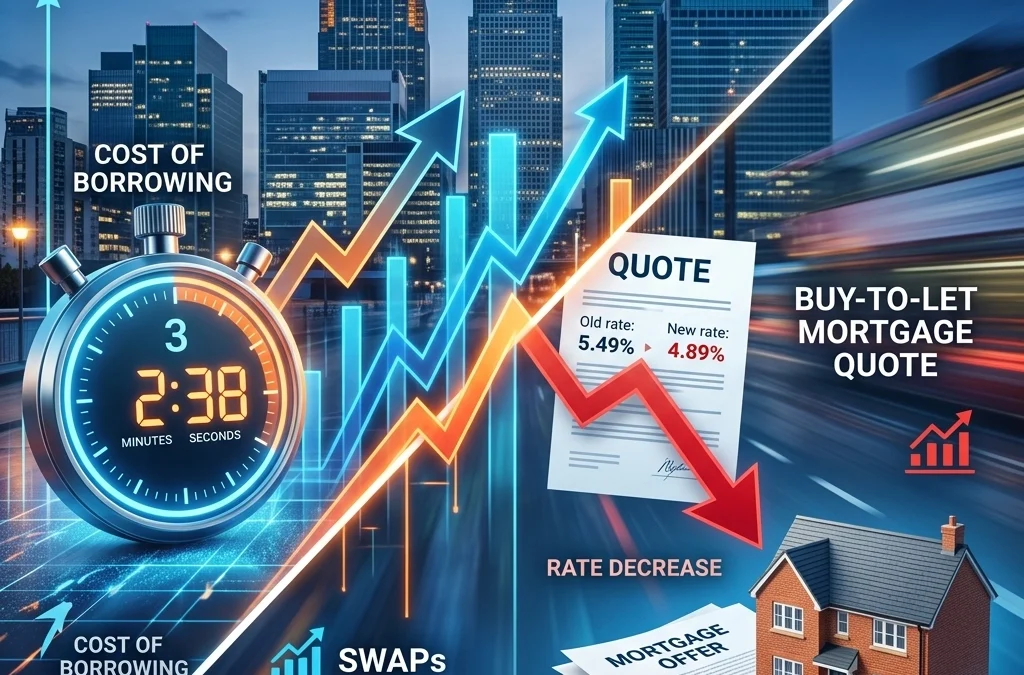
Ever wonder why your mortgage quote expires before you’ve even finished your coffee? It all comes down to "swap rates", the hidden engine behind your interest rate. Check out our quick guide on how they work and how to lock in a deal before the market moves again.
You’ve finally found the perfect property in Chadderton. You’ve crunched the numbers, spoken to your broker, and received a quote for a 4.8% fixed-rate mortgage. You take the night to sleep on it.
The next morning, you call back to proceed, only to be told the rate is gone. It’s now 5.1%.
"But I only spoke to you yesterday!" you say.
The culprit? Swap rates.
If you’re a landlord in 2026, understanding swap rates is no longer just for the "finance geeks." It is the difference between a profitable portfolio and a deal that doesn’t stack up. At Hunter Capital, we see this frustration every day. Here is the simple, jargon-free breakdown of what is happening behind the scenes and how you can stay ahead of the game.
What Exactly is a Swap Rate?
Think of a swap rate as the "wholesale" price of money.
When you go to a supermarket to buy a loaf of bread, the price you pay is based on what the supermarket paid the baker, plus their own profit margin.
Mortgage rates work the same way. Lenders (the supermarkets) don’t just have trillions of pounds sitting in a vault. To offer you a fixed-rate mortgage, they often have to "borrow" that money from the financial markets.
A swap rate is an agreement between two financial institutions to "swap" interest payments. One side pays a fixed rate, and the other pays a floating rate (usually tied to something called SONIA in the UK).
Lenders use these swaps to protect themselves. If they give you a fixed rate of 5% for five years, but the cost of borrowing money suddenly shoots up to 7%, the lender loses money. By using a swap, they lock in their costs so they can safely offer you a fixed rate.
The simple formula:
Swap Rate + Lender’s Margin = Your Mortgage Rate.

Why Your Quote Just Changed (The "Under 3 Minutes" Version)
If swap rates are the wholesale price of money, why do they change so fast?
Swap rates are based on expectations. They aren't necessarily about what the Bank of England Base Rate is today; they are about what the market thinks the Base Rate will be in two, three, or five years.
Here is why your quote might have changed overnight:
- Inflation Data: If the latest inflation report comes out higher than expected, the market panics. They assume the Bank of England will have to keep interest rates higher for longer to cool the economy. Swap rates jump instantly.
- Global Events: Whether it’s a shift in the US economy or political instability in Europe, global markets are interconnected. If investors get nervous, they move their money around, which pushes swap rates up or down.
- Lender Capacity: Sometimes, it’s not even the swap rate. If a lender releases a "market-leading" rate and gets flooded with thousands of applications in 24 hours, they will pull the product simply because they can’t process the paperwork fast enough.
In 2026, markets move faster than ever. Digital trading means that as soon as a piece of economic news hits the wires, the "price of money" adjusts in milliseconds. By the time your broker picks up the phone, the "old" price is history.
The Impact on Buy to Let Landlords
For landlords, especially those looking at how to get approved for a buy-to-let mortgage in 2026, swap rates are the single biggest factor in your monthly cash flow.
When swap rates rise, your "Interest Cover Ratio" (ICR) gets squeezed. Lenders don't just care if you can afford the mortgage; they need the rent to cover the mortgage payment by a certain percentage (usually 125% to 145%).
If the interest rate on your quote jumps from 4.5% to 5% because of a swap rate spike, your "stressed" monthly payment goes up. Suddenly, the rent you’re charging in Oldham might not be enough to satisfy the lender's stress test, and your loan amount gets reduced.
This is why we’ve seen a massive shift toward limited company mortgages for local landlords, as they often offer more favorable tax treatment and slightly different stress-testing rules that help offset the volatility of interest rates.

Is 2026 the Year of the "Quick Trigger"?
We are currently seeing a trend where mortgage products have a "shelf life" of just a few days, sometimes even hours. Earlier this year, we noted that buy-to-let rates hit 4.8%, but those deals were snapped up by investors who were ready to move immediately.
In the current Oldham market, from the booming streets of Chadderton to high-yield HMOs, the "wait and see" approach is costing landlords thousands.
If you are looking at HMO mortgages to maximize yields, the margins are even tighter. A 0.25% shift in the swap rate can be the difference between a 10% yield and an 8% yield.
How Hunter Capital Helps You Lock It In
At Hunter Capital, we don't just find you a rate; we manage the clock. Here is how we help our clients navigate the "swap rate trap":
- Early Warnings: We monitor the swap markets daily. If we see a trend suggesting rates are about to rise, we call our clients before the lenders pull their products.
- Ready-to-Go Applications: We make sure your paperwork (ID, bank statements, proof of rent) is ready before we find the deal. When a great rate appears, we can hit "submit" in minutes.
- Direct Access: As brokers, we often get a few hours' notice before a lender withdraws a product. That window is small, but for a prepared landlord, it’s enough time to secure a deal.
Whether you are a first-time buyer in Oldham or an experienced investor with 20 properties, speed is your best friend.

Frequently Asked Questions
Do swap rates affect tracker mortgages?
Generally, no. Tracker mortgages are usually tied directly to the Bank of England Base Rate. Swap rates primarily affect fixed-rate mortgages. However, if swap rates are rising, it’s usually a sign that the market expects the Base Rate to rise soon, too.
How often do swap rates change?
Every single business day. They fluctuate constantly during market hours based on economic news and trading activity.
Can I "lock in" a swap rate myself?
Not directly as an individual. You lock in the mortgage product that is priced based on those swap rates. Once you have a mortgage offer, that rate is usually guaranteed for a set period (often 3 to 6 months), regardless of what happens to swap rates in the meantime.
Why do some lenders have higher rates if the swap rate is the same?
Lenders have different "appetites for risk" and different overheads. A specialist lender for foreign national mortgages might have a higher margin than a high-street bank because the manual underwriting process is more complex.
The Bottom Line
Swap rates are the "weather" of the mortgage world. You can’t control them, but you can certainly carry an umbrella.
If you get a mortgage quote that works for your numbers, don't sit on it. In a market where "yesterday's rate" is a distant memory, being decisive is the most valuable skill a landlord can have.
Don't let the market move without you.
If you’re looking to purchase or remortgage a property in Oldham or across the UK, let’s get your application ready now so we can strike when the rates are right.
Book a free mortgage consultation with Naz Islam and the Hunter Capital team today.