
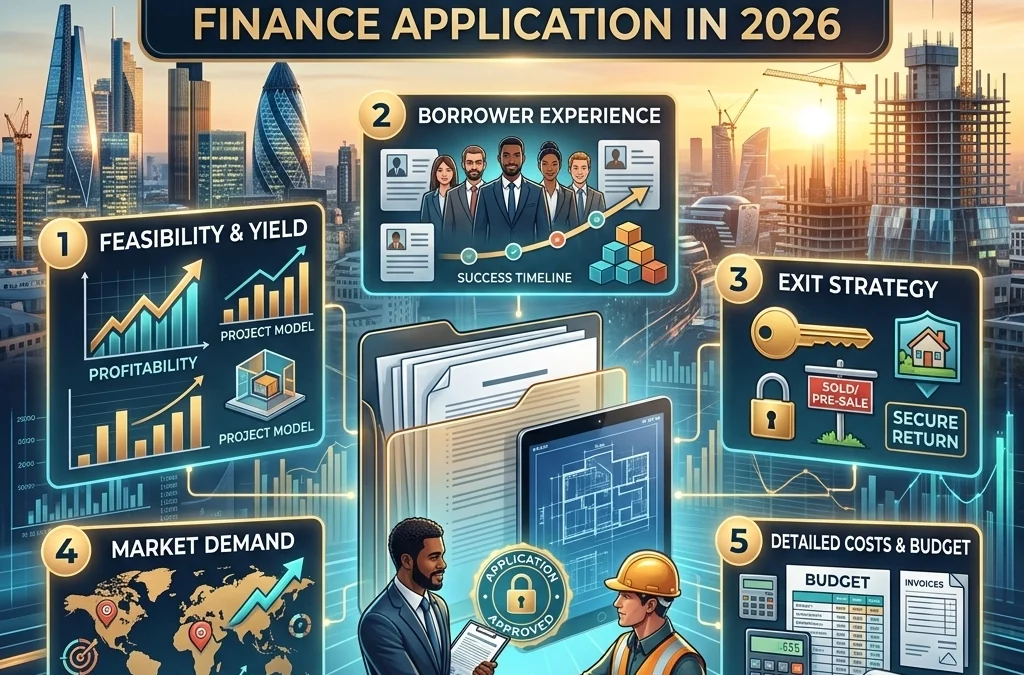
Facebook Summary: Thinking about starting a new project in 2026? Getting your property development finance application right is the first step to success. Here are the 5 essential things lenders are looking for right now to help you secure the best deal and get those shovels in the ground.
Hi, I’m Naz Islam, Director at Hunter Capital. If you’re reading this, you’re likely planning a property project and need the funds to make it happen.
The world of development finance has changed a bit as we’ve moved into 2026. While the core principles remain, lenders are more detail-oriented than ever. They aren’t just looking at the "bricks and mortar"; they are looking at the person behind the project, the stability of the plan, and the reality of the numbers.
At Hunter Capital, we spend our days talking to lenders across the UK. We know what makes them tick and, more importantly, what makes them say "yes."
If you want to secure the best rates and terms for your next project, here are the five key things you need to nail in your application.
1. Proven Experience (The Track Record)
In 2026, "having a go" isn't enough for most specialist lenders. They want to see that you’ve successfully completed similar projects before.
Lenders look at your CV not just to see how long you've been in the game, but to see if you’ve handled a project of this specific scale and type. If you’re moving from a simple flat refurbishment to a 10-unit ground-up build, the lender will see a "gap" in experience.
What if you’re new?
If you don't have a massive portfolio, don't worry. You can bridge this gap by surrounding yourself with a "dream team." This includes:
- An experienced project manager.
- A main contractor with a solid reputation.
- An architect who has worked on similar schemes.
Lenders feel much safer when they see an experienced team supporting a developer. They want to know that if a problem arises, which it often does in construction, there are people on board who know how to fix it.

2. A Rock-Solid, Detailed Development Plan
A vague idea written on a napkin won't cut it. Lenders in 2026 want a comprehensive pack that tells the story of the project from start to finish.
Your plan should cover:
- Location Analysis: Why this area? If you’re building in a place like Oldham, for example, is there a demand for the specific type of housing you’re creating?
- Planning Permission: Is it already in place? Lenders rarely offer full development finance without "Full Planning Permission."
- ESG and Sustainability: By 2026, environmental standards are a big deal. Lenders often offer better rates for "green" developments that meet high energy efficiency standards.
- The Build Schedule: A realistic timeline of how long each phase will take.
Lenders are looking for "professionalism." A well-presented plan shows you are serious and that you’ve done your homework. If you need help structuring this, the team at Hunter Capital can guide you through what a "perfect" pack looks like.
3. A Clear and Realistic Exit Strategy
This is arguably the most important part of your application. The lender isn't giving you a 30-year mortgage; they are giving you short-term capital. They want to know exactly how they are going to get their money back.
There are usually two main "exits":
- Sale of the Property: You finish the build, sell the units, and pay off the loan. In this case, lenders will look at the local market to see if your "Gross Development Value" (GDV) is realistic.
- Refinance: You might decide to keep the property as a Buy-to-Let or an HMO. To do this, you’ll need to transition to a long-term mortgage. Lenders will want to see that you qualify for refinance options or buy-to-let products before they agree to the initial development loan.
If your exit strategy is "I'll see how the market looks in 18 months," your application will likely be rejected. You need a Plan A and a Plan B.
4. A Realistic Contingency Fund
If there is one thing we’ve learned over the last few years, it’s that costs can change. Material prices fluctuate, and unexpected issues often hide underground.
Lenders in 2026 are looking for a healthy contingency, usually around 10% to 15% of the build cost. If you submit a budget that is "penny-perfect" with no room for error, lenders will actually see it as a red flag. It tells them you aren't being realistic about the risks of construction.
Having a robust contingency shows the lender that you are prepared for the worst-case scenario. It proves you have the liquidity to finish the project even if things get a bit more expensive than planned.

5. Budget Accuracy and "Skin in the Game"
Finally, let’s talk about the money. Lenders look at two financial aspects: the project’s budget and your own financial health.
The Project Budget:
Every cost must be accounted for, professional fees, CIL payments, marketing costs, and finance interest. If your budget looks "light," a lender’s surveyor will pick it up immediately, which can damage your credibility.
Skin in the Game:
While 100% development finance exists in very specific joint-venture scenarios, most lenders want to see that the developer is putting their own money into the deal. Usually, this means you’re covering the deposit for the land or a portion of the build costs.
Lenders feel more comfortable when you have a financial stake in the outcome. It shows you are committed to seeing the project through to completion.
Why the Local Market Matters (Focus on Oldham)
Being based in the UK, we see how much location impacts an application. For developers looking at areas like Oldham or Greater Manchester, lenders are currently quite positive.
Oldham is seeing a lot of regeneration, making it an attractive spot for residential developments. When you can show a lender that your project aligns with local council goals or meets a specific housing shortage in an area like Oldham, it adds another layer of security to your application.

How Hunter Capital Makes the Difference
Applying for development finance can feel like a full-time job. Between gathering documents and chasing lenders, it’s easy to get overwhelmed.
That’s where we come in. At Hunter Capital, our USP is simple: we provide expert support and compare products to get you the best deal.
We don’t just send your application to one bank and hope for the best. We have access to a wide range of our lenders, including high-street banks, private funds, and specialist development lenders that you won't find on the high street.
We help you:
- Sense-check your budget and plan.
- Present your experience in the best possible light.
- Compare rates, arrangement fees, and "exit fees" to find the lowest overall cost.
- Manage the process from the first "hello" to the final drawdown.
Whether you are looking for bridging finance to secure a site quickly or full development finance for a major project, we’ve got your back.
Frequently Asked Questions (FAQs)
How much can I borrow for a development project in 2026?
Most lenders will offer up to 60-70% of the land cost and 100% of the build costs, provided the total loan doesn't exceed a certain percentage (usually 65-70%) of the final Gross Development Value (GDV).
Do I need a surveyor's report?
Yes. Every development lender will appoint an independent monitoring surveyor to verify your costs and track the progress of the build before releasing funds in stages.
Can I get finance for an HMO conversion?
Absolutely. HMO mortgages and conversions are very popular in 2026. Lenders will look closely at the "article 4" directions in your specific local authority.
What is the typical interest rate?
Rates vary wildly depending on your experience and the "LTV" (Loan to Value). By working with a broker like us, you ensure you aren't paying more than you have to.
Ready to Start Your Next Project?
Getting your finance in place shouldn't be the hardest part of your development. With the right preparation and the right team by your side, you can secure the funding you need to grow your portfolio.
If you’re planning a project in the UK and want to know what your options are, let’s have a chat. We offer a simple, friendly, and expert service to help you navigate the market.
Book a Free Consultation with Hunter Capital Today
Or, if you’d prefer to just have a quick chat about a potential site, feel free to contact us directly. We’re here to help you build the future.