Facebook Summary: Confused between a commercial mortgage and a bridging loan? We’ve broken down the key differences to help you decide which fits your 2026 property goals. Whether you need speed or long-term stability, here’s how to choose the right finance for your business.
If you’re looking at property in 2026, you already know the market isn't waiting for anyone. Whether you’re eyeing up a new office space in the heart of Oldham or looking to expand your portfolio across Greater Manchester, the way you fund that move is everything.
At Hunter Capital, we see business owners and investors grappling with the same big question every day: "Should I go for a commercial mortgage or a bridging loan?"
It’s a bit like choosing between a reliable family estate car and a turbocharged motorbike. One is built for the long haul and comfort; the other is built to get you to the finish line before anyone else can blink.
In this guide, I’m going to break down exactly how these two types of business finance work, the costs involved, and: most importantly: which one is right for your specific situation in today's fast-moving market.
What Exactly is a Commercial Mortgage?
Think of a commercial mortgage as the "forever home" of business finance. It is a long-term loan used to buy or refinance property that’s used for business purposes. This could be anything from a retail unit or a warehouse to a large office block.
In 2026, commercial mortgages remain the gold standard for stability. If you plan to stay in your premises for the next 15 to 25 years, this is usually the path you’ll take.
The Good Stuff:
- Lower Interest Rates: Because the lender knows you’re in it for the long term, the rates are significantly lower than short-term options.
- Predictable Cash Flow: You’ll have set monthly payments, making it much easier to manage your business's overheads.
- Capital Growth: As you pay off the mortgage, you’re building equity in an asset that (hopefully) is increasing in value.
The Not-So-Good Stuff:
- They Take Time: Getting a commercial mortgage approved isn't an overnight job. Expect a mountain of paperwork, valuations, and credit checks that can take several months.
- Strict Criteria: Lenders will want to see a rock-solid business plan, proven accounts, and a healthy deposit (usually 25% or more).
Enter the Bridging Loan: The Speed Demon
A bridging loan is exactly what it sounds like: a "bridge" to get you from point A to point B. It’s a short-term, high-speed loan designed to be paid back quickly, usually within 12 to 18 months.
In the current 2026 property climate, speed is often the difference between winning a deal and losing it. If you’re at an auction and need to complete a purchase within 28 days, a standard mortgage simply won't cut it. That’s where bridging finance saves the day.
The Good Stuff:
- Lightning Fast: We can often get bridging finance arranged in a matter of days, not months.
- Flexible: Lenders are often more interested in the value of the property and your "exit strategy" (how you'll pay the loan back) than your monthly salary.
- Seize Opportunities: Perfect for buying properties at auction, renovating "unmortgageable" buildings, or jumping on a deal before a competitor does.
The Not-So-Good Stuff:
- Expensive: Speed comes at a price. Interest rates are higher than mortgages, and there are often arrangement fees to consider.
- The Pressure is On: You need a clear plan to pay it back. Whether that’s selling the property or moving onto a long-term mortgage, you can’t stay on a bridge forever.

Head-to-Head: Which One Wins?
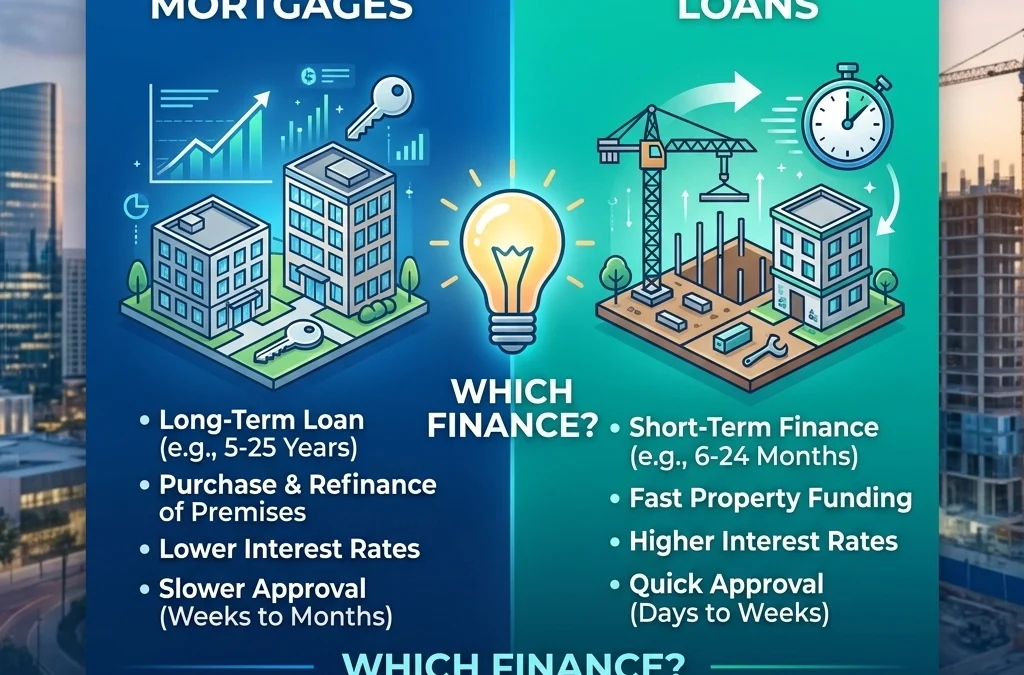
To make it even simpler, let's look at them side-by-side:
| Feature | Commercial Mortgage | Bridging Loan |
|---|---|---|
| Loan Term | 15 – 30 years | 1 – 18 months |
| Speed to Fund | 2 – 4 months | 1 – 3 weeks |
| Interest Rate | Lower (Annual %) | Higher (Monthly %) |
| Best For | Long-term stability | Speed and flexibility |
| Repayment | Monthly capital & interest | Usually "rolled up" or paid at the end |
| The Goal | Owning your business home | Winning the deal or fixing a property |
Why Businesses are Choosing One over the Other in 2026
The choice usually comes down to your "Why."
The "Forever Home" Scenario
Imagine you run a successful local firm in Oldham. You’ve been renting your unit for five years, and the landlord has decided to sell. You know the location is perfect, your customers know where you are, and you want to stay there for the next decade.
The Winner: Commercial Mortgage. It’s the cheapest way to secure your business’s future and stop paying rent.
The "Auction Bargain" Scenario
You find a run-down commercial building that has been empty for years. It’s a steal, but it needs a full renovation before it’s fit for purpose. A traditional bank won't lend on it because it doesn't have a functioning kitchen or heating system. You need to buy it now and fix it up fast.
The Winner: Bridging Loan. You use the bridge to buy and renovate the building. Once the work is done and the value has increased, you refinance onto a commercial mortgage.

The "Bridge-to-Let" Strategy
A trend we’re seeing a lot of in 2026 is the "Bridge-to-Term" strategy. Many of our clients use a bridging loan to snap up a property quickly: perhaps an HMO (House in Multiple Occupation): and then immediately start the application for a long-term mortgage while the renovations are happening.
This gives you the best of both worlds: the speed to secure the asset and the long-term low rates to make the investment profitable. If you’re looking at the multi-let market, check out our thoughts on why 2026 is the year of the multi-let property.
How Hunter Capital Makes the Choice Easier
Choosing between these two isn't just about picking a product; it’s about looking at your whole business strategy. That’s where Naz and the team come in.
We don’t just work with one bank. We compare over 100+ lenders to find the one that fits your specific needs. Whether you need a high LTV (Loan to Value) or you have a complex credit history, we know which lenders are currently "hungry" for business in the Oldham and Greater Manchester area.
We take the "finance jargon" and turn it into plain English. We’ll tell you straight if a bridging loan is too risky for your project or if a commercial mortgage is going to take too long for the deal you’re trying to close.
Common Questions (FAQ)
1. Can I switch from a bridging loan to a mortgage later?
Yes! In fact, this is the most common way to use a bridging loan. It’s called your "exit strategy." We can help you arrange the mortgage so it’s ready to take over the moment your bridge ends.
2. Do I need a big deposit for a commercial mortgage?
Generally, you’ll need around 25% to 30% of the property value. However, some lenders are more flexible depending on the strength of your business accounts.
3. Is bridging finance only for property developers?
Not at all. We see small business owners using it for things like paying an unexpected tax bill, purchasing stock at a discount, or simply managing cash flow while waiting for a larger long-term loan to come through.
4. How much can I borrow?
This depends entirely on the property value and your business income. With bridging loans, the focus is more on the property value; with mortgages, it’s more about your ability to pay every month.
Ready to Secure Your Business Property?
The 2026 market is full of opportunity, but you need the right fuel to reach your goals. Whether you’re looking for the long-term security of a commercial mortgage or the rapid-response power of a bridging loan, don't try to navigate it alone.
Naz and the team at Hunter Capital are here to do the heavy lifting for you. We’ll look at your situation, explain your options clearly, and get you the best deal from across the market.
Contact us today for a free, no-obligation consultation. Let’s get your business moving.